
What is a PTO Power Take Off:
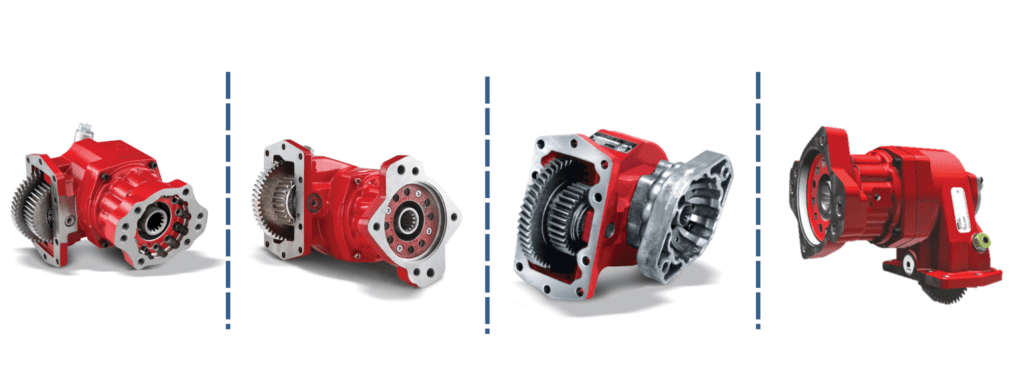
A Power Take Off, commonly referred to as a PTO is a unit that sends power from a vehicle’s main power source, i.e. engine to the auxiliary equipment on the vehicle. Vehicles using PTOs can run efficiently without needing a secondary engine. They’re also more robust, more cost-effective than a secondary power source and more space-efficient.
Types of PTOs:
PTOs can be used on a range of applications, including refuse vehicles, fire tenders, tippers, hook and skip loaders plus many more. The most commonly used PTO are the rear-mounted and side-mounted PTOs, as these bolt directly onto the main power source, which is mainly used in modern applications.
Although there are many other types of PTOs, including top-mounted and split shaft attachments. Despite the different mounting options, all units serve the same purpose which is to power the auxiliary equipment on the applications.
Are all applications programmed for power take off options?
In order to use a PTO, applications require special wiring and programming along with different apertures on the transmission to allow for PTO mounting. Therefore, applications need to be ordered with the ‘PTO ready’ option and configured by the chassis manufacturer.
Hydraulics vs Mechanical shift
The 2 main types of independent PTOs are mechanical and hydraulic. Mechanical PTOs are engaged by shifting one gear to another, this is done through using a lever, cable or air pressure. Whereas hydraulic PTOs are engaged by using clutch mechanisms. Often also called a Hotshift PTO.
Why is my applications so noisy?
It’s common knowledge that PTOs can suffer from excess noise on the roads. Often compared to a whining and grinding noise, this is usually caused by interference between gears and the transmission, in order for the PTO and transmission to work side by side there needs to be a certain amount of backlash between the gears. Backlash is a term used to describe the clearance between gears so they can move around freely without interference. However, too much backlash can cause a rattle, so it’s important to correctly fit the PTO to the transmission.
Parker Chelsea offers a quiet gear technology PTO in which the noise suppression system works to dampen the gear rattle between the PTO and the transmission. Helping the curb the noise emission, by smoothing out vibrations in diesel engines whilst not affecting the durability and torque capacity of the PTO.
Do I need a PTO maintenance programme?
As with any hydraulic components, it’s important to undertake regular maintenance and checks in order to keep proper and safe equipment. Parker Hannifin recommends following the below maintenance schedule:
Daily: Check all air, hydraulic and working mechanisms before operating the PTO.
Monthly: Inspect for any leaks, and tighten any lose hardware if required. Torque all bolts to PTO specifications. Ensure that splines are lubricated and perform any maintenance as required.
How do I increase life expectancy of my PTO?
One of the main potential issues with a power take off unit can be premature spline wear caused by torsional vibrations. This is why regular lubrication of splines is advised as part of your scheduled maintenance. Parker Chelsea developed a wet spline technology that helps to provide a constant flow of fresh oil to the PTO and pump shafts in order to prevent the issue of spline wear.
Contact Us